 how-to
Professional Picture Framing Wimbledon: 2026 Guide
Table of Contents
- Why Professional Picture Framing Wimbledon Services Beat Off-the-Shelf Frames
- Conservation Framing Standards: What Fine Art Trade Guild Membership Means
- Choosing the Right Mount for Art: Materials That Protect and Present
- Bespoke Picture Framing Costs: What Affects the Price
- The Professional Picture Framing Process, Step by Step
- Shadow Box Framing for Jerseys, Medals and 3D Objects
- How to Choose a Framer: Questions Worth Asking
- Frequently Asked Questions
Last Updated: September 16, 2026
Why Professional Picture Framing Wimbledon Services Beat Off-the-Shelf Frames
A ready-made frame costs a fraction of a bespoke one, and for a poster you'll replace next year, that's fine. For anything you care about, it isn't. Professional picture framing Wimbledon services exist because a frame is not decoration wrapped around art; it is a protective enclosure, and the cheap version is usually a poor one.
What Bespoke Framing Actually Protects Against
Bespoke framing manages four threats that ready-made frames ignore: ultraviolet light, humidity, physical contact, and acidic materials. UV exposure fades pigments gradually and invisibly until the change is irreversible. Acidic backing boards and mount board migrate into paper over years, causing the brown discolouration known as foxing. Glass or acrylic that touches the artwork can bond to it in humid conditions. A properly built frame separates the art from the glazing with a mount, seals the back, and uses materials tested to a recognised standard.
When a Ready-Made Frame Is Good Enough
Not every piece needs conservation treatment, and any honest framer will tell you so. A mass-produced poster, a temporary seasonal print, or a child's drawing you plan to rotate every year is fine in a standard frame with a basic mount. The threshold is value and intent. If the piece is irreplaceable, signed, limited-edition, or likely to be handed down, the extra cost of bespoke work is small next to the cost of losing it.
Conservation Framing Standards: What Fine Art Trade Guild Membership Means
The Fine Art Trade Guild is the UK trade body that sets recognised standards for picture framing, and its membership scheme is the closest thing the industry has to an independent quality marker. HF Framing ltd is a member, which matters more than it sounds: Guild membership requires adherence to published framing standards rather than a framer's own judgement. When you're comparing framers, membership is a reasonable first filter, because it signals that someone external has defined what "correct" means.
The Four Levels of Conservation Framing
The Guild's framing standards define levels of protection, and understanding them stops you over- or under-buying:
- Level 1 (Basic): Suitable for decorative pieces with no long-term value. Standard backing, minimal protection.
- Level 2 (Conservation): Acid-free materials and UV-filtering glazing. The sensible default for most original art and photography.
- Level 3 (Museum): Fully reversible mounting, the highest-grade boards and glazing, all materials tested for stability.
- Level 4 (Museum, highest specification): Reserved for significant or high-value works where every component must meet the strictest criteria.
For most household collections, Level 2 is the practical choice. Ask which level you're being quoted for, and get it in writing.
Choosing the Right Mount for Art: Materials That Protect and Present
Choosing the right mount for art comes down to one question: does the board touch the artwork, and is it safe if it does? The mount, also called the window mount, does two jobs. It holds the art away from the glazing, and it gives the eye breathing room around the image. Get the material wrong and it will damage the piece it's meant to protect.
Mount Board Choices and Their Trade-Offs
| Mount Board Type | Protection Level | Best For | Trade-Off |
|---|---|---|---|
| Standard (wood pulp) | Low | Posters, temporary prints | Turns acidic over time |
| Conservation (buffered) | Medium-high | Original art, photography | Not for all paper types |
| Museum (100% cotton rag) | Highest | Valuable, long-term pieces | Highest cost |
| Foam board | Structural only | Backing, not visible mounts | Not a conservation material |
The subtlety most guides miss: buffered conservation board is excellent for most paper, but it isn't automatically right for every artwork. Some photographs and certain textiles prefer unbuffered or specific materials. A framer who asks what the piece is before recommending a board is doing the job properly.
Bespoke Picture Framing Costs: What Affects the Price
Bespoke picture framing costs vary because the frame is built to order, so pricing depends on the components you choose rather than a fixed shelf price. There is no standard rate card, and any framer quoting a flat figure without seeing the piece is guessing. The main drivers are the moulding you select, the glazing type, the mount board grade, and the complexity of the job.
- Moulding: Solid wood and hand-finished profiles cost more than composites.
- Glazing: Standard glass is cheapest; UV-filtering and anti-reflective options add cost.
- Mount board: Museum-grade cotton rag sits at the top of the range.
- Complexity: Shadow boxes, multiple apertures, and 3D objects take more labour.
- Size: Larger pieces need stronger frames and more material.
For an accurate figure, ask for a quote based on the actual piece. You can request a quote from HF Framing ltd once you know what you're framing.
The Professional Picture Framing Process, Step by Step
The professional framing process runs from consultation to finished, ready-to-hang piece, and a good framer involves you at the decisions that matter. Here is how it works in practice.
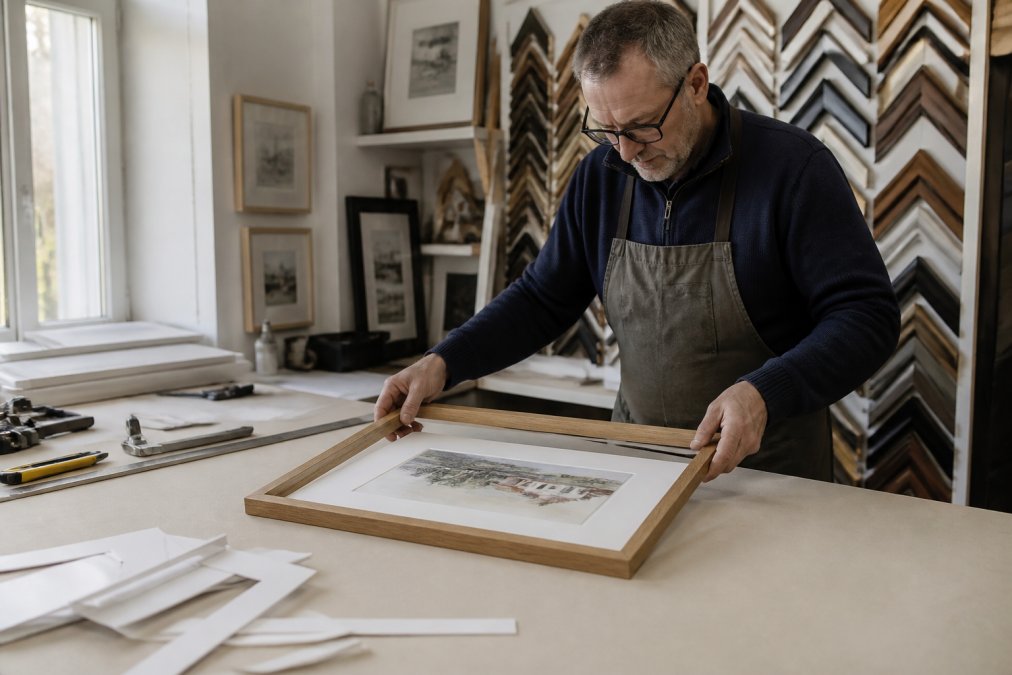
- Consultation. You discuss the piece, where it will hang, and your budget. The framer recommends a framing level and materials.
- Material selection. You choose the moulding, mount colour and width, and glazing. This is where the look is decided.
- Measuring and cutting. The frame, mount and glazing are cut to the piece, with allowance for expansion.
- Mounting. The artwork is attached using reversible methods, so it can be removed later without damage.
- Assembly and sealing. The frame is built, the back is sealed against dust and insects, and hanging hardware is fitted.
- Collection or delivery. HF Framing ltd offers collection and delivery, so you don't have to transport fragile work yourself.
Shadow Box Framing for Jerseys, Medals and 3D Objects
Shadow box framing is the technique for displaying three-dimensional objects, and it solves a problem flat framing can't. A vintage sports jersey, a set of medals, or a commemorative item needs depth, and it needs the object held securely without being damaged. A shadow box is a deep frame with the object mounted on a backing, often behind glass, with the depth built to suit the item.
The craft is in the mounting. A jersey should be supported so its weight doesn't pull at the fabric. Medals need fixings that won't scratch or tarnish the metal. Everything should be reversible, so the object can be removed in future without evidence it was ever framed. This is genuinely specialist work, and it's worth asking directly whether a framer does it in-house.
How to Choose a Framer: Questions Worth Asking
Choosing a framer is a short interview, and a good one welcomes the questions. Use these to separate a genuine specialist from a shop that simply sells frames.
- Are you a member of the Fine Art Trade Guild?
- Which conservation level do you recommend for this piece, and why?
- Is the mount board acid-free, and is it buffered or unbuffered?
- What is the UV rating of the glazing you're proposing?
- Will the mounting method be fully reversible?
- Do you handle shadow box framing in-house?
- What's the realistic turnaround, and do you offer collection and delivery?
The answers tell you more than any showroom. A framer who explains the trade-offs, rather than pushing the most expensive option, is the one to use.
Frequently Asked Questions
What is the difference between standard and bespoke picture framing?
Standard framing uses pre-made frames in set sizes, while bespoke picture framing Wimbledon services build the frame, mount and glazing around your exact piece. Bespoke lets you choose moulding profile, mount colour, glazing type and backing to suit the artwork. It also allows conservation-grade window mounterials for anything valuable or sentimental, which off-the-shelf frames rarely offer.
How do I choose the right mount for art?
Choosing the right mount for art depends on the medium and value of the piece. Watercolours and prints benefit from a wide mount in a neutral tone to draw the eye inward. Photographs often suit a narrower, crisp mount. For anything you want to preserve, specify museum-grade or conservation mount board, which is buffered and free from the acids that cause paper to yellow and discolour over time.
What window mounterials are best for archival picture framing?
Archival framing uses conservation-grade mount board, acid-free hinging tape, UV-filtering glazing and a sealed backing to keep dust and insects out. These window mounterials meet conservation framing standards set out by the Fine Art Trade Guild, which grades framing from budget to museum level. If your piece is valuable or you want it to last decades, ask your framer which Guild level they are working to.
How long does a professional framing service typically take?
Turnaround depends on the complexity of the job and the window mounterials ordered. A straightforward bespoke frame with a standard mount often takes one to two weeks, while conservation work, shadow boxes or custom finishes can take longer. If you have a deadline, tell your framer at the consultation so they can confirm whether the timeline is achievable before you commit.
Framing decisions are hard to reverse once the wrong materials are against your artwork, and the cost of getting it right is far smaller than the cost of getting it wrong. HF Framing ltd provides bespoke framing with expert consultation, collection and delivery, and Guild-recognised standards on every piece, from a single photograph to a full gallery wall. Make a booking with HF Framing ltd and give your work the enclosure it deserves.