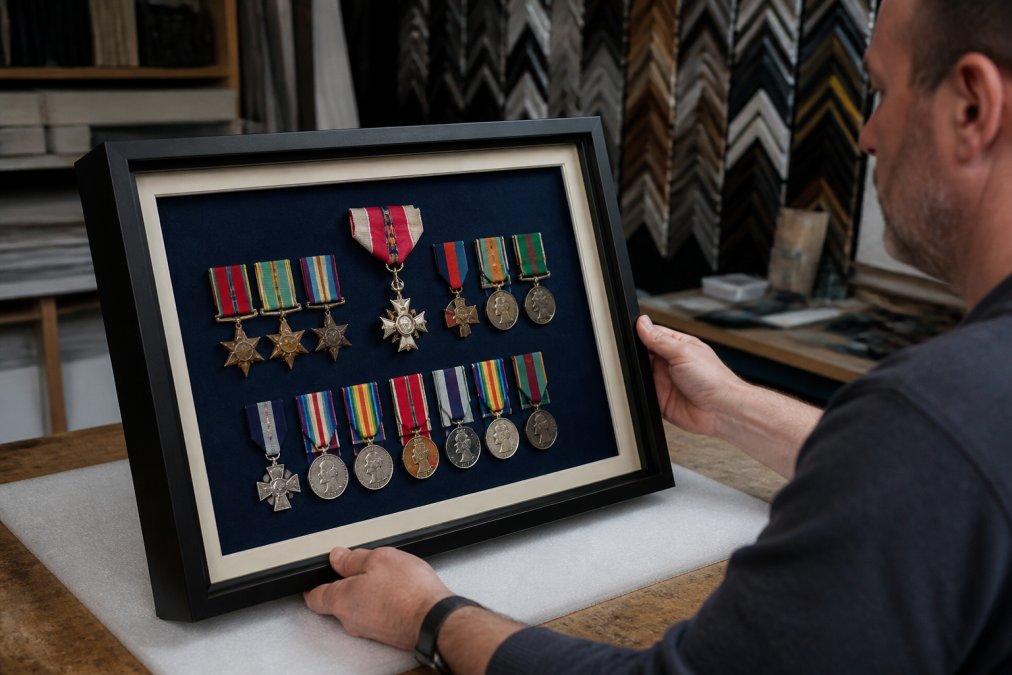
 how-to
How to Display Medals Properly: A Step-by-Step Guide
Table of Contents
- What You'll Need Before You Start
- Step 1: Choose Your Display Method
- Step 2: Prepare and Clean Your Medals Safely
- Step 3: Arrange Medals in the Correct Order
- Step 4: Secure Medals Without Damaging Ribbons
- Step 5: Mount and Frame for Long-Term Protection
- When to Use Military Medal Mounting Services
- Common Mistakes to Avoid
- Frequently Asked Questions
Last Updated: September 11, 2026
What You'll Need Before You Start
To display medals properly, you start with the right materials, not the right frame. Most people who get this wrong buy the frame first and then discover their grandfather's ribbon has been crushed against glass for a decade.
Medals are small, heavy, and often irreplaceable, and the wrong mount does more damage in five years than fifty years in a drawer (si.edu).
Gather these before you begin:
- Acid-free backing board (conservation or museum grade)
- Cotton or nitrile gloves for handling metal and ribbon
- Soft brush and a lint-free cloth
- Ribbon-safe fixings: Melinex strips, cotton thread, or stainless-steel pins
- Shadow box frame deep enough to clear the medal's relief
- UV-filtering glazing if the piece will hang in daylight
If any of that sounds unfamiliar, the Fine Art Trade Guild guidance on framing standards is worth reading before you spend anything.
Step 1: Choose Your Display Method
The right display method depends on whether you want to handle the medals again. Flat mounting suits regular wear and parade use. Shadow boxes suit permanent, protected display.
Shadow Boxes vs. Flat Mounting
A shadow box is a deep frame that holds the medal away from the glass, allowing the ribbon, suspender, and any accompanying items to sit in three dimensions. Flat mounting presses the medal closer to the backing, which suits a single campaign medal with a short ribbon.
Method | Best For | Protection Level | Reversible? |
|---|---|---|---|
Shadow box | Groups, framed groups, dress medals | High, fully enclosed | Yes, with care |
Flat mounting | Single medals, active wear | Moderate | Yes |
Medal bar | Wear on uniform | Low, exposed | Yes |
Display case | Loose collections | Moderate | Yes |
For most family collections, a shadow box is often recommended. The extra depth costs more in materials but prevents the single most common failure: ribbon fibres flattening permanently against glass.
Step 2: Prepare and Clean Your Medals Safely
Cleaning is where well-meaning owners do the most damage. Never polish a medal with metal cleaner, and never scrub a ribbon.
Use a dry soft brush to lift dust from the metal. For silver that has darkened, leave it alone unless you know the alloy and its original finish. Aggressive polishing strips patina and, on some medals, removes the very definition that gives the piece its value.
Ribbons are fabric. They fade, fray, and bleed. Do not wash them. Do not iron them directly. If a ribbon is creased, a light steam from a distance is the only intervention I'd risk, and even then, test on a hidden section first.
Step 3: Arrange Medals in the Correct Order
Order matters more than most people realise. Medals worn or displayed out of sequence look wrong to anyone who knows the conventions, and correcting it later means dismantling the whole frame.
The standard rule is seniority: the highest award sits closest to the wearer's heart, which in a framed display means the top-left as you look at it, working right and down. Campaign medals follow in date order of the campaign, not the date they were issued.
If the group includes a gallantry award, it sits first. Long service and commemorative medals come last. Where you're unsure, check the official medal ordering guidance from the Ministry of Defence before you commit to a layout.
Lay everything out on a flat surface at the actual spacing you plan to use. Photograph the arrangement. You will thank yourself when you're pinning it inside a deep frame.
Step 4: Secure Medals Without Damaging Ribbons
Secure each medal by the suspender or the ribbon, never through the metal. The goal is to hold the piece in place without applying pressure to any single point.
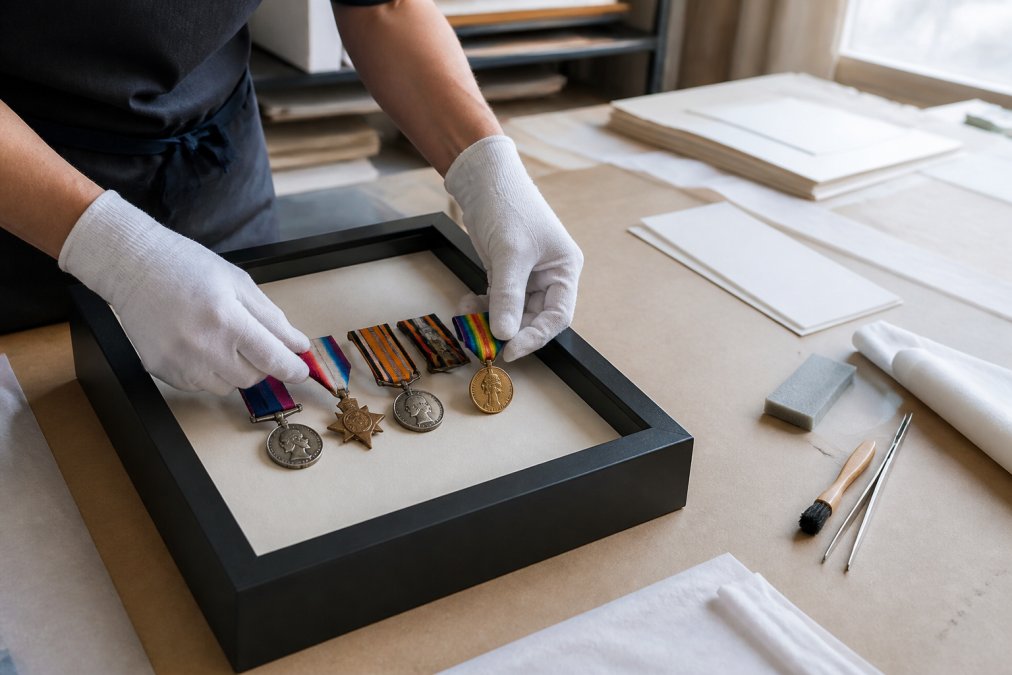
The methods that work:
- Melinex strips: clear polyester folded into a loop that passes behind the ribbon and pins to the board. Invisible and reversible.
- Cotton thread: stitched through the ribbon's edge and tied behind the board. Use only on ribbons you're prepared to accept tiny stitch holes in.
- Stainless-steel pins: for heavier medals, driven through the backing board behind the suspender, not through the ribbon itself.
What most guides miss is tension. A medal that's held too tightly will distort the ribbon over time; one held too loosely will shift and scratch the glazing. Aim for firm but relaxed.
Step 5: Mount and Frame for Long-Term Protection
Long-term protection comes down to three things: glazing, spacing, and sealing.
Use UV-filtering glazing. Standard glass blocks almost no ultraviolet light, and UV is what fades ribbon dye. Acrylic glazing is lighter and safer for larger frames, though it scratches more easily.
Leave a gap of at least 15mm between the medal's highest point and the glass. This allows air to circulate and prevents condensation forming on the metal.
Seal the back of the frame with a dust cover, and hang it away from direct sunlight and radiators. A south-facing wall in a warm room is the worst place for any framed textile.
When to Use Military Medal Mounting Services
Military medal mounting services exist for a reason: some jobs genuinely need a specialist. If your group includes gallantry awards, fragile or pre-1945 ribbons, or medals with significant monetary or sentimental value, hand it to someone who does this daily.
The same applies to bespoke medal framing for large groups. Framing eight or ten medals with correct spacing, consistent depth, and matching mounts is a design problem as much as a craft one. Getting the proportions wrong makes even a valuable collection look cluttered.
At HF Framing Ltd, we handle this kind of work through our Wimbledon Art Studios base, with collection and delivery available. The consultation covers layout, mount colour, frame profile, and glazing choice before anything is cut.
Common Mistakes to Avoid
The mistakes that ruin the way you display medals are almost always the same handful, repeated.
- Framing without measuring depth. A shadow box that's too shallow presses the ribbon against glass.
- Using ordinary mount board. Standard board is acidic and will yellow the ribbon over time. Medal ribbon preservation depends on conservation-grade materials throughout.
- Polishing silver. It removes patina and, on some medals, the original finish.
- Glue or tape. Never reversible, always damaging.
- Hanging in direct light. UV fades ribbon faster than anything else in the room.
- Skipping the layout test. Rearranging inside a sealed frame is far harder than rearranging on a table.
If you'd rather not risk any of these, that's exactly the point at which a framer earns their fee. For a single modern medal in good condition, doing it yourself with the right materials is entirely reasonable. For anything inherited, valuable, or part of a group, the cost of a professional mount is usually less than the cost of one mistake.
Frequently Asked Questions
What is the correct order to mount military medals?
Military medals are worn in order of precedence, which is determined by the medal's rank in the Order of Wear. This order is set by the Central Chancery of the Orders of Knighthood and published in the London Gazette. Campaign medals generally follow gallantry awards. If you are unsure, check the official Order of Wear or ask a specialist mounting service to confirm the sequence before framing.
Should medals be framed behind glass?
Yes, but use UV-filtering glass or acrylic. Standard glass offers no protection against fading, and medal ribbons are particularly vulnerable to light damage. UV-filtering glazing blocks most harmful rays. For depth, a shadow box frame with a gap between the medal and the glazing prevents crushing and allows air circulation, which helps slow tarnishing. Avoid sealed frames that trap moisture.
How do you prevent medals from tarnishing in a display?
Tarnishing is caused by moisture, sulphur compounds, and handling. Use acid-free, conservation-grade materials for the backing and mounts. Handle medals with cotton gloves, and avoid touching the metal directly. Keep the display out of damp rooms such as kitchens or bathrooms. If the frame is not sealed, periodic inspection helps. Silver-dip strips or tarnish-inhibiting papers can be placed inside the frame, but do not let them touch the medal.
Is it better to mount medals on a board or in a shadow box?
It depends on the medal's shape and your display goals. Flat mounting on an acid-free board suits medals that lie flat and will be framed behind glass with no depth. Shadow boxes are better for three-dimensional items, such as medals with thick ribbons, clasps, or accompanying items like cap badges. A shadow box also allows you to include a photograph or citation alongside the medals without crowding.
Medal displays fail slowly, and by the time the damage shows, it's often permanent. HF Framing ltd offers bespoke medal framing with conservation-grade mounts, UV-filtering glazing, and a consultation that covers ordering, spacing, and long-term protection before a single cut is made. We're a member of the Fine Art Trade Guild, based at Wimbledon Art Studios, with collection and delivery for larger collections. Make a booking and we'll help you get the arrangement right the first time.