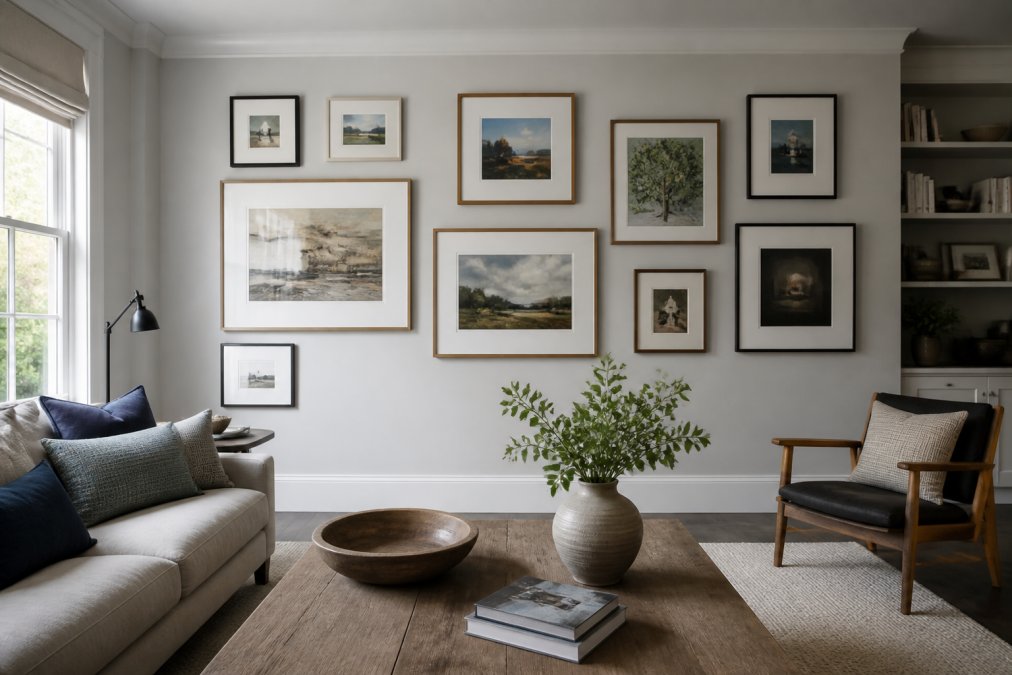
 how-to
How to Display an Art Collection Cohesively (2026 Guide)
Table of Contents
- Why Cohesion Matters When You Display an Art Collection
- Gallery Wall Layout Ideas That Actually Work
- How to Choose Matching Picture Frames Without Making Everything Look Identical
- Art Hanging Spacing Rules Every Collector Should Know
- Lighting and Framing Choices That Protect and Present Your Work
- Common Mistakes That Break the Cohesion of a Display
- Frequently Asked Questions
Last Updated: 14 September 2026
Why Cohesion Matters When You Display an Art Collection
Learning how to display art collection cohesively is less about buying expensive frames and more about controlling three things: layout, spacing, and consistency. Get those right and even a modest collection of prints looks intentional. Get them wrong and a wall of valuable originals can look like a jumble.
At HF Framing ltd, we handle bespoke framing for collectors, photographers and gallery owners across South West London, and the same problem comes up in most consultations. People own beautiful work but have no system for grouping it. The fix is a repeatable set of rules, not a designer's eye.
Cohesion is what happens when every piece on a wall feels like it belongs to the same conversation. It comes from repetition of shape, frame style, mount width and spacing, not from matching subject matter. A display of mixed landscapes, portraits and abstracts can still read as one collection if the presentation is consistent.
That distinction matters because it changes what you spend money on. Below, we'll show you exactly how to plan a gallery wall, choose frames that relate to each other without looking identical, and apply the spacing rules that separate a professional hang from a DIY one.
Gallery Wall Layout Ideas That Actually Work
Three layouts cover almost every situation: the grid, the salon hang, and the asymmetric arrangement. Each suits a different collection size and wall shape.
The grid works best for pieces of similar size. Align outer edges, keep equal gaps, and treat the whole group as one rectangle. It reads as calm and ordered.
The salon hang fills a wall edge to edge with mixed sizes, usually centred on a strong middle piece. It suits larger collections and period interiors.
The asymmetric layout balances different weights rather than aligning edges. It's the hardest to get right and the easiest to get wrong.
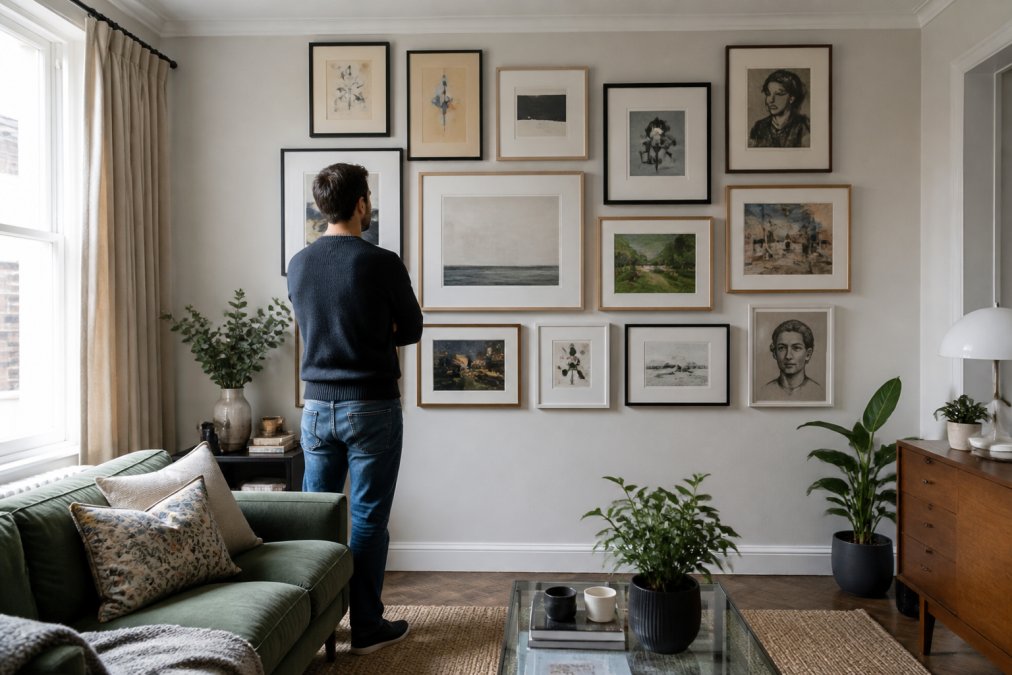
Grid, Salon and Asymmetric Layouts Compared
| Layout | Best For | Collection Size | Difficulty |
|---|---|---|---|
| Grid | Similar-sized pieces | 4-9 works | Easy |
| Salon | Mixed sizes, large walls | 8-20+ works | Moderate |
| Asymmetric | Varied sizes, awkward walls | 3-7 works | Hard |
Start by laying every piece on the floor in front of the wall. Rearrange until the group looks balanced before you touch a hammer. It saves filling and repainting holes.
How to Choose Matching Picture Frames Without Making Everything Look Identical
Matching frames doesn't mean buying the same frame twenty times. It means choosing frames that share enough visual language to relate to each other while letting each piece breathe.
The elements that create cohesion are finish, profile width, and mount depth. If two frames share a finish and a similar profile, they'll read as a family even if one is 2cm wide and another is 4cm. When you start mixing metal and wood, or matt black and gilt, you need a stronger reason than personal taste.
A useful rule: pick one variable to repeat and one to vary. Repeat the frame finish across the whole collection; vary the profile width according to the size of the artwork. A large canvas can carry a wider moulding than a small etching without either looking wrong.
When to Match Frames and When to Mix Them
Match frames when the works are of similar type and value, or when they'll hang in the same room as a single unit. Mix them when you're grouping different media, such as a photograph next to an oil, or when you want to signal that pieces were acquired at different times.
If you're unsure, our consultation service at HF Framing ltd exists precisely for this decision. Seeing mount samples against your actual artwork removes the guesswork.
Art Hanging Spacing Rules Every Collector Should Know
The standard rule is to hang artwork so the centre of the piece sits at eye level, roughly 145cm to 152cm from the floor. That single measurement fixes most hangs.
Between frames in a group, keep gaps consistent. A gap of 5cm to 8cm works for most domestic walls; larger gaps make a group feel disconnected, smaller ones make it feel cramped. On a staircase or above furniture, measure from the furniture, not the floor, and leave 15cm to 25cm of breathing room above the top surface.
For a single statement piece on a large wall, aim to fill roughly two-thirds to three-quarters of the available width. Anything smaller floats; anything larger feels squeezed.
Lighting and Framing Choices That Protect and Present Your Work
Light is the second half of presentation and the first line of defence for your collection. Ultraviolet light fades pigments, and daylight through a window is the usual culprit.
For valuable or sentimental pieces, ask for glazing with UV filtering and an archival mount. According to guidance from the Fine Art Trade Guild on framing standards, correct mounting and glazing are central to long-term preservation. Conservation-grade mount board is acid-free, which prevents the brown staining that cheaper board causes over time.
For lighting, avoid direct sunlight and use diffused or angled light across the surface rather than straight at it. Angled light reduces glare and reveals texture in oils and textured prints. If you're lighting a whole wall, keep the colour temperature consistent across every fitting.
HF Framing ltd is a member of the Fine Art Trade Guild, and we advise on glazing and mount options as part of every consultation rather than as an upsell. If you're framing a valuable oil or a family photograph, that conversation should happen before the frame is cut, not after.
Common Mistakes That Break the Cohesion of a Display
The failures are predictable, and most of them are avoidable before you spend anything.
- Hanging too high. Work placed above eye level looks like it's floating away from the room.
- Inconsistent gaps. One 3cm gap next to a 12cm gap destroys the group's rhythm.
- Mixing mount widths. Different mount borders on similar-sized pieces make the frames look mismatched even when they aren't.
- Ignoring the furniture below. A sofa or sideboard creates a visual baseline; artwork should relate to it.
- Hanging before planning. Drilling first and rearranging later costs you a wall of filled holes.
A common mistake is treating each piece as an individual purchase rather than part of a set. If you buy frames one at a time over months, keep a note of the finish, profile and mount width so the next purchase matches. Otherwise you end up with a wall of near-misses.
Frequently Asked Questions
How do you make a gallery wall look cohesive?
Start with one unifying element, such as a consistent frame finish, a shared mount width or a repeated colour drawn from the artwork itself. Limit your display art collection to a defined palette of two or three frame tones, then vary size and orientation instead of style. Keeping consistent spacing between every piece, usually 5 to 8cm, ties the whole arrangement together even when the artworks differ in subject or medium.
Should all picture frames match in a gallery wall?
Not necessarily. Matching every frame works well for a formal, uniform look, but it can flatten a collection with varied styles. A common approach is to match frames within a group and vary them between groups, or to keep one element constant, such as mount colour or frame width, while changing the finish. This gives cohesion without making the display look repetitive.
What are the art hanging spacing rules for a mixed-size collection?
Hang the centre of your arrangement at roughly eye level, about 145 to 150cm from the floor. Leave 5 to 8cm between frames so the group reads as one unit, and keep the gaps equal across the whole wall. For pieces of very different sizes, align the centre lines rather than the top or bottom edges, which keeps the overall shape balanced.
How do you arrange art of different sizes on one wall?
Sketch the layout on paper or use paper templates taped to the wall before drilling. Anchor the arrangement with your largest piece and build outward, balancing visual weight rather than matching dimensions. Group smaller works in pairs or clusters to stop them getting lost beside a large canvas, and keep the outer edges of the whole arrangement roughly within a rectangle so the eye reads it as a single composition.
Building a cohesive display takes planning, and the framing decisions are the hardest part to reverse once they're made. HF Framing ltd offers expert consultation, bespoke frames and mounts, and collection and delivery from our base at Wimbledon Art Studios, so your collection is handled by people who frame for galleries and collectors every week. Make a booking with HF Framing ltd and get professional guidance on frames, mounts and spacing before a single hole is drilled.