 ultimate-guide
Bespoke Framing Service for Photographers: A 2026 Guide
Table of Contents
- Why a Bespoke Framing Service for Photographers Beats Off-the-Shelf Frames
- Choosing Frame and Mount Materials for Different Photographic Styles
- Archival Mounting Techniques for Photography That Protect Prints Long-Term
- Museum-Grade Glass for Photo Frames: What It Blocks and Why It Matters
- Bespoke Frame Turnaround Times: What to Expect and How to Plan
- What a Professional Framing Consultation Should Cover
- How Professional Framing Supports a Photographer's Business
- Frequently Asked Questions
Last Updated: 13 September 2026
Why a Bespoke Framing Service for Photographers Beats Off-the-Shelf Frames
A bespoke framing service for photographers is a made-to-measure framing solution designed around the specific dimensions, materials and presentation needs of a photographic print, rather than a standard-sized frame bought from a shelf. At HF Framing ltd, we frame work for photographers, galleries and collectors. The difference between a bespoke frame and a ready-made one shows up the moment a print goes on the wall. Ready-made frames force your image into someone else's proportions. A bespoke frame is built around the photograph, which means the mount borders sit where they should and the print is held with materials chosen for its long-term protection.
The gap is not just aesthetic. A frame that fits properly protects the print inside it. A frame that nearly fits leaves gaps where dust and light get in.
Choosing Frame and Mount Materials for Different Photographic Styles
Frame and mount choices should follow the photograph, not the room's colour scheme. A documentary print and a formal portrait rarely want the same treatment, and getting this right is where a bespoke framing consultation earns its keep.
Frame Profiles and Finishes That Suit Documentary, Landscape and Portrait Work
Documentary and street photography usually reads best in a slim, matte black or dark-stained profile. The frame recedes, and the image carries the weight. Landscape work often suits a slightly wider profile in a natural wood tone, which echoes the subject without competing with it. Portrait and studio work can take a deeper, more traditional moulding, particularly when the print is large and the frame needs visual mass to hold it on the wall.
Gloss finishes reflect light and can pull attention away from the print. Matte finishes absorb it. If your work will hang opposite a window, this choice matters more than the colour.
Mount Board Colours and Borders That Change How a Print Reads
Mount board is not decoration. It is the visual pause between the photograph and the frame, and it changes how the eye reads the image. A generous off-white border gives a print air and makes it feel considered. A narrow border tightens the composition and pushes the image forward.
Colour matters too. A warm white mount flatters skin tones and golden-hour landscapes. A cool white suits high-contrast black and white and architectural work. Choosing the wrong undertone can make a perfectly printed image look slightly off, and most people cannot say why.
Archival Mounting Techniques for Photography That Protect Prints Long-Term
Archival mounting means fixing a print in place using materials that will not discolour, stain or chemically react with the paper over time. For photographers, this is the difference between a print that can be sold as a limited edition and one that quietly degrades in its frame.
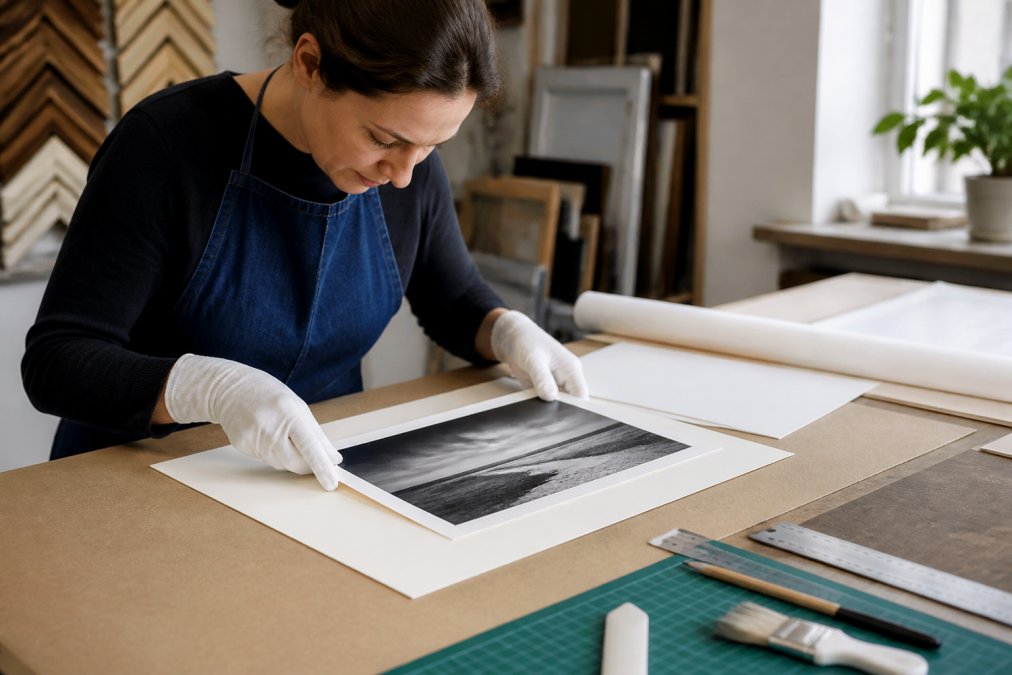
The core principle is simple: nothing in contact with the print should be acidic, and nothing should be permanent unless you want it to be. Standard mount board and ordinary tapes contain acids that migrate into paper, causing the yellow-brown staining known as foxing. Archival boards are buffered and acid-free. Hinges are made from paper or linen tape that can be reversed by a conservator without harming the print.
What most guides miss is that the backing matters as much as the mount. A sealed backing board keeps out dust, insects and airborne pollutants, and it is one of the cheapest upgrades available on any frame.
Museum-Grade Glass for Photo Frames: What It Blocks and Why It Matters
Museum-grade glass is a glazing product that filters ultraviolet light and reduces reflections, protecting a print from the two things that fade it fastest: UV radiation and visible light. Ordinary picture glass does neither.
UV light is the main cause of fading and colour shift in photographic prints, and it reaches them from daylight through windows, from fluorescent tubes and from halogen spotlights (canada.ca). UV-filtering glazing blocks the majority of that radiation. Anti-reflective coatings handle the second problem, which is that standard glass turns a framed print into a mirror the moment a light source is behind the viewer.
There is an honest trade-off. Museum glass costs more than standard glazing, and on a low-value print it may not be worth it. On a signed edition, a large format print or anything hung in a bright room, it is the single most effective protection you can add.
Bespoke Frame Turnaround Times: What to Expect and How to Plan
Bespoke frame turnaround times depend on the frame specification, the mounting method and the glazing chosen, and they should be confirmed at the point of order rather than assumed. A straightforward frame with standard glazing moves through the workshop faster than one requiring museum glass, a hand-finished moulding or a complex multi-aperture mount.
Planning is where most photographers get caught out. Exhibition deadlines, client delivery dates and Christmas gifting all cluster at the same points in the year, and workshops fill up accordingly. The practical approach is to book the consultation as soon as the print is finalised, not when the deadline is already close.
| Stage | What Happens | How to Plan For It |
|---|---|---|
| Consultation | Materials, mount and glazing agreed | Book as soon as the print is finalised |
| Order confirmation | Specification and timeline fixed in writing | Confirm turnaround in writing at this point |
| Workshop production | Cutting, mounting, assembly | Allow buffer before any fixed deadline |
| Collection or delivery | Frame handed over or shipped | Arrange collection or delivery in advance |
If you have a hard deadline, say so at the consultation. It is far easier to plan around a fixed date at the start than to rush a frame at the end.
What a Professional Framing Consultation Should Cover
A proper consultation covers four things: the print itself, the materials, the hanging environment and the budget. If a framer skips any of these, you are being sold a frame rather than advised on one.
The print comes first. Its size, paper type, surface finish and value all shape what happens next. A glossy fibre print and a matte cotton rag print behave differently under glazing, and a valuable print needs a reversible mounting method.
Then the environment. Where will it hang? How much light hits it? Is the wall damp, or above a radiator? These answers decide the glazing and the backing.
Finally, budget. A good framer will tell you where the money is best spent and where you can save without compromising the print. That might mean museum glass on the one print that needs it and standard glazing on the rest.
How Professional Framing Supports a Photographer's Business
Professional framing is a commercial decision as much as an aesthetic one. A photographer selling prints is selling a finished object, and the frame is part of that object. Buyers judge presentation, and a print that arrives in a well-made frame with a clean mount reads as a more serious piece of work than the same print in a budget frame.
There is a practical side too. Consistent framing across a portfolio or an exhibition makes a body of work look deliberate. When every frame, mount width and glazing type matches, the viewer's eye moves between images instead of catching on the presentation. That coherence is difficult to achieve with off-the-shelf frames bought at different times.
For editioned work, archival materials also protect the value you are asking clients to pay for. A buyer purchasing a limited edition wants to know the print will still look right in a decade.
Framing a body of work well takes more than picking a moulding you like. It takes materials matched to the print, mounting that can be reversed, and glazing that holds back the light doing the damage. HF Framing ltd handles that side of it, from expert consultation through to collection and delivery, with archival mounting and museum-grade glazing options built into the specification. As a member of the Fine Art Trade Guild, we work to recognised standards for the materials that sit against your prints. Make a booking with HF Framing ltd and get your work framed the way it deserves to be seen.
Frequently Asked Questions
What is the difference between bespoke framing and standard framing?
Standard frames come in fixed sizes with basic mounts and glazing, so a print is trimmed or float-mounted to fit. A bespoke framing service for photographers measures your actual print, cuts a mount to suit its proportions, and lets you choose moulding, mount board, glazing and backing separately. That means archival-grade materials, a mount sized to your image rather than the other way round, and a finish matched to the work. The result is a frame built around the photograph, not a photograph squeezed into a frame.
How does museum-grade glass protect photographic prints?
Museum-grade glass for photo frames filters most ultraviolet light, which is the main cause of fading and yellowing in colour prints, and some versions also cut reflections and block heat. UV filtering slows deterioration rather than stopping it completely, so keep framed work out of direct sunlight. Combined with archival mounting techniques for photography, such as acid-free boards and photo-safe tapes, museum-grade glazing gives prints a far better chance of holding their tone for decades.
Are acid-free mounts necessary for professional photography?
Yes, if you want the print to last. Standard mount board and backing contain lignin and other acids that migrate into paper over time, causing brown staining and brittleness. Acid-free, lignin-free boards and photo-safe hinging tapes keep the print chemically stable and let it expand and contract with humidity without buckling. For work you are selling, exhibiting or archiving, acid-free materials are the baseline rather than an upgrade.
How long does a bespoke framing service typically take?
Bespoke frame turnaround times depend on the complexity of the job, the materials chosen and how busy the workshop is. A single print in a standard moulding with a simple mount is usually quicker than a multi-piece gallery wall or a deep shadow box for a shirt and medals. If you have a fixed deadline, such as a show or a gift date, say so at the consultation and ask for the timeline in writing before you commit.