 ultimate-guide
Archival Quality Framing for Vintage Prints: A Guide
Table of Contents
- What Makes Framing Truly Archival?
- Choosing the Right Archival Framing Materials
- Does Humidity Affect Archival Framing Quality?
- Acid-Free Mounting Techniques for Paper Prints
- UV Protection Glass for Vintage Art: What to Know
- Your Framer Checklist: Questions to Ask Before Committing
- Conclusion: Preserving Your Vintage Prints for the Future
- Frequently Asked Questions
Last Updated: September 9, 2026
What Makes Framing Truly Archival?
The term "archival quality framing for vintage prints" gets thrown around loosely, but it has a precise meaning. Archival framing is the practice of using materials and techniques that will not degrade, discolour, or chemically interact with the artwork over time. Standard framing prioritises cost and immediate appearance; archival framing prioritises the long-term survival of the piece. For a vintage print, which may already be fragile, the difference between a standard frame and an archival one can mean the difference between preservation and gradual ruin.
Prints framed with acidic boards and non-archival adhesives often develop brown spots, known as foxing, or yellowing edges within a decade (loc.gov). The core principle is simple: every material that touches the print must be inert and stable. This includes the mounting board, the tape, the glazing, and even the frame itself. If any component is not archival, it can off-gas acids or trap moisture, accelerating the very decay you are trying to prevent.
Choosing the Right Archival Framing Materials
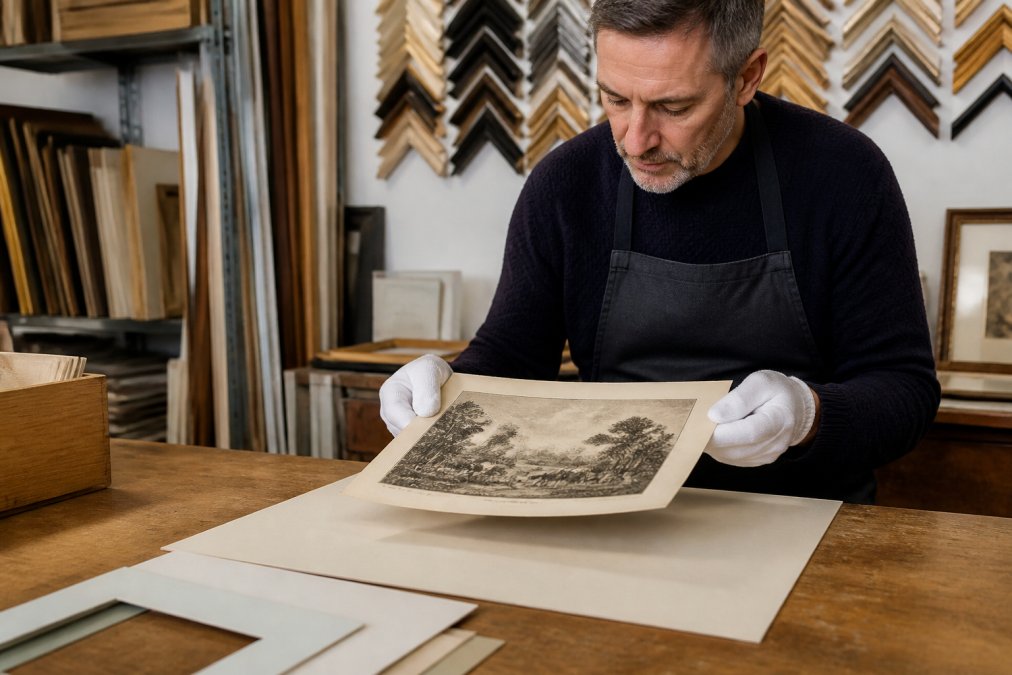
Selecting the correct materials is the foundation of any conservation-grade project. The conservation standard for paper-based artwork is defined by the Fine Art Trade Guild, which sets the benchmark for professional framing practice in the UK. When you request archival quality framing for vintage prints, you are asking for materials that meet or exceed these museum-level specifications.
Museum-Grade Mounting Boards vs. Standard Boards
The mounting board is the rigid backing your print rests against. Standard boards, often made from wood pulp, contain lignin and acids that migrate into the paper over time. Museum-grade boards, in contrast, are made from 100% cotton rag or purified wood pulp. They are buffered with an alkaline reserve to neutralise any acids that may develop. For a vintage print, a museum-grade board is not a luxury; it is a necessity. The pH of the board should be neutral or slightly alkaline, typically around 8.5, to counteract environmental acidity (archives.gov).
Why the Frame Itself Matters
The frame is not just a decorative border; it is the first line of defence against physical damage. A well-constructed frame should have a deep rebate, the lip that holds the glazing and backing in place, to prevent the artwork from touching the glass. It should also be sealed properly to keep out dust and insects. Wood frames are traditional, but you must ensure the wood is sealed, as raw timber can release acids and resins. Aluminium or sealed hardwood frames are excellent choices for archival projects.
Does Humidity Affect Archival Framing Quality?
Humidity is the silent enemy of vintage prints. Fluctuations in relative humidity cause paper fibres to expand and contract, leading to buckling, cockling, and eventual cracking of the emulsion. High humidity also encourages the growth of mould and mildew, which can permanently stain and weaken the paper structure. The ideal relative humidity for storing and displaying paper art is between 40% and 50% (si.edu). A stable environment is more critical than a perfect one; rapid swings in humidity are more damaging than a constant, slightly elevated level.
A properly constructed archival frame offers some protection. The backing board and glazing create a microclimate inside the frame, buffering the print from sudden changes in the room. However, a frame cannot fully protect against a persistently damp environment. If you are hanging vintage prints in a kitchen, bathroom, or an exterior wall that gets cold, you are risking condensation inside the frame. In these conditions, consider using a spacer between the print and the glazing to prevent the glass from touching the artwork, which can cause the print to stick to the glass due to trapped moisture.
Acid-Free Mounting Techniques for Paper Prints
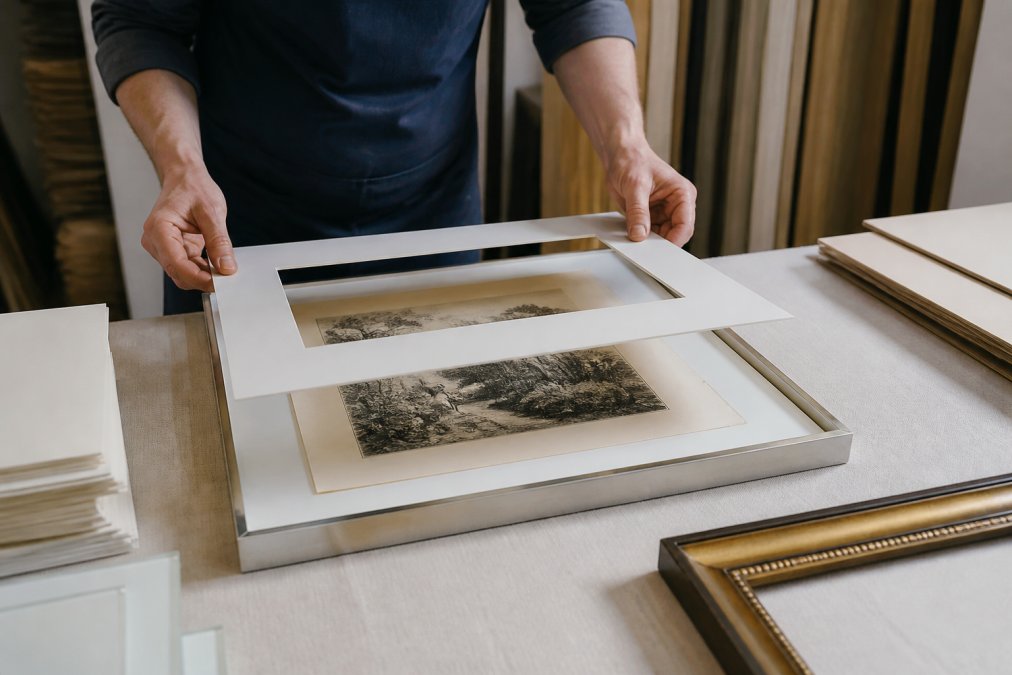
How the print is attached to the mounting board is where many framing jobs fail. The golden rule is reversibility: any mounting technique must allow the print to be removed without damage in the future. Acid-free mounting techniques for paper use either hinging or encapsulation. Hinging involves attaching the print to the board with small strips of Japanese tissue paper and a starch-based paste. The paste is water-soluble, so the hinges can be removed safely later. You should never use pressure-sensitive tape, rubber cement, or spray adhesive directly on a vintage print; these adhesives penetrate the paper and become nearly impossible to remove without tearing.
For smaller prints, a corner mount is a non-invasive alternative. Archival Mylar corners hold the print in place without any adhesive touching the artwork itself. This method is ideal for items you may want to remove or replace frequently. Whichever method you choose, the mounting process requires a steady hand and a clean, dry workspace. A common mistake is over-tensioning the hinges, which can cause the print to ripple as it expands and contracts with humidity changes.
UV Protection Glass for Vintage Art: What to Know
Light damage is cumulative and irreversible. Ultraviolet radiation is the primary culprit, causing fading, yellowing, and embrittlement of paper and inks. Standard glass blocks very little UV light, offering almost no protection. UV protection glass for vintage art is treated with a coating that filters out 97% to 99% of UV radiation. This is essential for any piece that will be displayed in a room with natural light or bright artificial lighting.
There are different grades of UV-filtering glass available. Conservation clear glass offers high UV protection with minimal colour distortion, making it a popular choice for detailed prints. Museum glass goes further, adding an anti-reflective coating that eliminates glare while providing the same UV filtration. The trade-off is cost; museum glass is significantly more expensive than conservation clear. For a vintage print with fading inks or delicate pigments, the investment in UV protection is non-negotiable. Even indirect sunlight can cause noticeable fading over a period of years.
Your Framer Checklist: Questions to Ask Before Committing
Choosing a framer is a decision that will affect the longevity of your artwork. Before you hand over a valuable piece, ask these questions to ensure the framer understands archival standards. The answers will tell you whether they are a true conservator or simply a picture framer with a mounting board.
- What materials do you use for the mount and backing? They should specify museum-grade, lignin-free boards, not just "acid-free."
- How will you attach the print to the board? The correct answer involves Japanese tissue hinges and starch paste, not tape or glue.
- What type of glazing do you recommend? A framer who does not proactively offer UV-protective glass may not be prioritising preservation.
- Is your workspace clean and climate-controlled? A dusty or damp workshop can introduce contaminants before the frame is even sealed.
- Can you guarantee reversibility? The framer should be able to explain how the print can be removed without damage in the future.
- Are you a member of a professional body? Membership in the Fine Art Trade Guild indicates a commitment to industry standards and training.
| Checklist Item | What a Good Answer Looks Like | Why It Matters |
|---|---|---|
| Mount board type | 100% cotton rag, museum-grade | Prevents acid migration and foxing |
| Print attachment | Japanese tissue hinges with starch paste | Allows reversible, damage-free removal |
| Glazing specification | UV-filtering glass, 97%+ protection | Blocks fading and embrittlement |
| Professional accreditation | Member of Fine Art Trade Guild | Confirms adherence to conservation standards |
The cost of bespoke framing reflects the materials and skill involved. While online frames may seem cheaper, they rarely use archival materials or offer the consultation needed to protect a valuable piece. For a gallery wall or a family heirloom, professional expertise is often a worthwhile investment.
Conclusion: Preserving Your Vintage Prints for the Future
Preserving a vintage print is an act of stewardship. The choices you make today determine whether the piece survives for the next generation. Archival quality framing for vintage prints is not about aesthetics alone; it is a technical process that requires the right materials, the right environment, and the right expertise. Skimping on any element, from the mounting board to the glazing, compromises the entire system.
This is where professional guidance matters. At HF Framing Ltd, our consultation process covers every detail, from selecting museum-grade boards to advising on the correct UV-protective glass for your specific print. As a member of the Fine Art Trade Guild, we are committed to the highest standards of conservation framing. We also offer collection and delivery services, ensuring your precious pieces are handled safely from your home to our workshop at Wimbledon Art Studios.
Frequently Asked Questions
What mounterials are required for museum-grade archival framing?
Museum-grade framing requires conservation-grade materials at every layer. This means using 100% cotton rag or alpha-cellulose mounting boards that are acid-free and lignin-free, pH-neutral or buffered adhesives, and glazing that blocks over 99% of UV light. The frame itself should be sturdy and finished to prevent off-gassing. Crucially, everything must be reversible, meaning it can be removed without damaging the print. Professional framers who are Fine Art Trade Guild members can confirm their materials meet these conservation standards before you commit.
Does humidity affect archival framing quality?
Yes, humidity is one of the biggest threats to framed vintage prints. Fluctuating moisture levels cause paper to expand and contract, leading to buckling, cockling, and eventual cracking of the print surface. High humidity also encourages mould growth and can activate acids in non-archival mounterials. For this reason, archival framing should include a sealed backing to limit air exchange, and your home should stay between 40-50% relative humidity. Avoid hanging valuable prints in bathrooms, kitchens, or on external walls where condensation is common.
How do I identify if a frame is truly archival?
Look for clear labelling and ask direct questions. Genuine archival materials will state they are acid-free, lignin-free, and meet conservation standards. The mounting board should be cotton rag or alpha-cellulose, not wood pulp. Glazing should specify its UV filtration percentage, ideally 99% or higher. Be cautious of frames sold as 'acid-free' only on the surface layer, as the core may still contain harmful acids. A reputable framer will happily explain their material specifications and show you certificates or product information to back their claims.
Why is acid-free mounts essential for vintage prints?
Standard mount board contains lignin and acids that migrate into the print over time. This causes yellowing, brown spots known as foxing, and embrittlement of the paper. Acid-free mounts, made from cotton rag or purified wood pulp, removes this threat. The mat also creates a physical barrier between the print and the glass, preventing the artwork from sticking to the glazing due to condensation. For vintage prints, this separation is critical because any contact with moisture can cause irreversible damage to the image surface.
What is the difference between standard and archival glazing?
Standard glass blocks some UV light but still allows a significant portion through, which fades inks and dyes over time. Archival glazing, often called conservation or museum glass, blocks 99% or more of UV radiation while remaining optically clear. Premium options also feature anti-reflective coatings so the artwork is clearly visible without glare. The choice depends on where you hang the piece and how much natural light it receives. For valuable vintage prints, UV-protective glazing is a worthwhile investment to slow fading dramountically.
How should vintage prints be mounted to prevent long-term damage?
Vintage prints should never be glued or dry-mounted permanently, as this destroys their value and prevents future conservation. The correct approach uses hinges made from Japanese tissue and wheat starch paste, applied sparingly to the back of the print. The hinged print is then attached to an acid-free mounting board, allowing the paper to expand and contract naturally with temperature changes. This method is fully reversible. For larger or fragile pieces, a professional may recommend encapsulation or edge-mounting techniques to provide support without altering the original.
Preserving your vintage prints requires more than just a frame; it requires a partner who understands conservation. Make a booking with HF Framing ltd for a consultation, and let us help you protect your artwork with archival quality framing that will stand the test of time.